The Beat Sheet

The Beat Sheet is a blog about insect pest management issues relevant to Australia's northern grain region of Queensland and northern New South Wales. This team blog is updated by entomology staff from Queensland Primary Industries and Fisheries. Their contribution is supported by funding from the grains and cotton industries.

Monday, October 12, 2009

White heads and stem borer in wheat

Every year we receive reports of white heads in wheat, and while there are several possible causes of this symptom, one suspect implicated in the crime is a small stem boring larva called Ephysteris silignitis (Turner) belonging to the moth Family Gelechiidae.

Rod Collins and Hugh Brier did some investigative work back in 1998. They reared a couple of larvae through to the adult moths and had them identified by ANIC.

Rod Collins made the following observations: “The damage was usually confined to a single tiller per plant at a relatively low incidence through fields. Infected tillers seemed to have flowered normally, but soon after flowering the stem upwards from the last node (and including the head) died and was white in colour with no grain in the head. From a distance, these symptoms appeared to be the same as those of crown rot. However, infected tillers were green and apparently healthy from the last node (including the flag leaf) down. On closer examination, a small entry hole about the size of a pinhead was evident usually at or just below the first node up from the base of the plant. In some cases an exit hole was noted just above the last node.”

“When the stem was split open, you could follow where the larva had been up until the last node, where it was often found feeding on the tip of the stem just above the last node. In some cases, the larva had chewed through the tip and continued to move upwards towards the head. It appeared that once the stem began to dry out, the larva would bore a hole in the stem and exit. Only one larva was found per stem in all the plants that I saw.”

It seems not much is known about this species. It is believed to be a native species, one of three in this genus found in Australia. Ephysteris promptella is recorded as a pest of sugarcane in Australia. Ephysteris silignitis occurs widely in Australia south to about 35 degrees south and is thought to be confined to Australia. It is in the wettest parts e.g. Brisbane and Mt Bellenden Ker and the driest. It is common at Alice Springs. It was suggested that it may feed on grasses but there was no evidence.


Stem borer larva in wheat (Photo by Iain Macpherson)

At this stage the reports of isolated ‘white heads’ do not represent economic loss, but this stem borer is something to be aware of if those scattered white heads are observed in fields. There is no registered chemical control.

Labels: ,

Sunday, August 2, 2009

Winter cereal aphids – background to the potential impact of infestations

The most critical issues we face in managing cereal aphids currently is the lack of local knowledge about the likely impact of infestations on yield and quality (the damage thresholds).

In this article, I will not go over aphid basics i.e. identification and sampling. You can follow the links to previous articles to read about these
(http://thebeatsheet-ipmnews.blogspot.com/2008/09/cereal-aphids-in-wheat-and-barley.html).

In this posting, I want to discuss what is known, from overseas research, and what we might draw on from this work to help us make decisions about aphid management and control. This review may provide some useful information, in the absence of any locally generated data on aphid impacts. Surprisingly, there has been very little work done on cereal aphids in Australia.

General points
The literature, largely from North America and Europe, indicates that there can be significant differences in the way different cultivars respond to the impact of aphids. For this reason, it is important to use this information as general information that may assist in understanding how your crop may be responding to an aphid infestation. In the absence of local data, it is a useful starting point.

Aphids have a requirement for nitrogen (N) to complete development and reproduce. Honeydew is a by-product of their feeding. Essentially aphids compete with the plant for available N, which can impact on the plant in at different stages of crop development.

Early aphid infestations (from seedling)
Root and shoot growth may be impaired as a result of aphids competing for N. Inadequate N for the crop may make the crop more vulnerable to the impact of an aphid infestation.

Prolonged infestation can reduce tillering and result in earlier leaf senescence. Controlling aphids generally results in a recovery of the rate of root and shoot development, but there can be a delay.

Late aphid infestations
There is no impact on yield after grain has filled and is maturing (soft-hard dough).

Infestations that occur during booting to milky dough, particularly where aphids are colonising the flag leaf, stem and ear, result in yield loss. Generally, the distal grains in the head fail to fill. Infestations at this stage in which aphids colonise the leaves, particularly lower in the canopy, tend to result in grain with reduced N (protein) rather than a loss in yield. Aphids are intercepting the N being relocated from leaves to the filling grain.

The relative impact of timing and location of infestation makes sense if you review it along with what is known about the contribution of different parts of the crop to yield. The figure below illustrates the contribution of the upper leaves, stem and ear to the yield of wheat and barley (GRDC Winter Cereal Crop Growth Guide 2005
http://www.grdc.com.au/director/events/grdcpublications?item_id=8D607A46EDDFD98A822CFAEC7FCC4EC2&pageNumber=1).


Ongoing research
There is currently research being conducted on cereal aphids, by QPIF and the Northern Grower Alliance (NGA).

In 2008, initial trial work by QPIF and NGA showed different results (see the GRDC Update, Goondiwindi, 2009 papers for NGA results. Briefly, NGA trial work showed an overall yield benefit of around 10% from using seed dressings containing imidacloprid. QPIF results showed no difference from seed treatment, but a yield benefit where a foliar treatment (pirimicarb) was applied at head emergence.

Article by Melina Miles

Labels: ,

Monday, October 20, 2008

Armyworm in wheat

Over the past couple of weeks there have been numerous reports of armyworm in both barley and wheat. The appearance of armyworm in wheat raises a number of questions:
1) Do they behave the same way in wheat as in barley in relation to the type of damage they cause
2) what is their damage potential and is there an economic threshold?
3) What sort of strategy can be used to monitor and manage populations?

For information on armyworm identification see previous Beatsheet postings on armyworms.
http://thebeatsheet-ipmnews.blogspot.com/2007/10/can-you-confidently-identify-armyworm.html

http://thebeatsheet-ipmnews.blogspot.com/2007/09/watch-for-armyworms-in-barley-and-oats.html

There is no reason to expect armyworm to behave differently in wheat to barley. This means you can expect to see feeding on leaves whilst the crop is still green, and then on stems as the crop dries down further.

Characteristic armyworm damage in winter cereals
During the vegetative growth phase, plants can tolerate considerable leaf feeding. Leaves may look tattered from the eaten-out leaf margins. Faecal pellets around the base of plants are another indication of armyworm infestation. Armyworm generally do not require control during the vegetative stage.


Ragged flag and other leaves on a maturing barley crop


The most serious armyworm damage in cereal crops occurs when larvae feed on the upper flag leaf and stem node as the crop matures. Larvae target the stem node as the leaves become dry and unpalatable, and the stem is often the last part of the plant to dry. Head cutting begins at this time.

One large larva can sever up to seven heads of barley a day. One larva a square metre can cause a loss of 70 kg/ha grain per day. A larva takes around 8-10 days to develop through the final, most damaging instars, so the crop is susceptible to maximum damage for this period.


Head cutting in barley caused by armyworm

Calculating an economic threshold
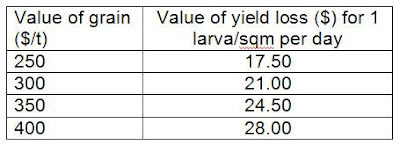
The following table shows the value of yield loss incurred by 1 larva/square m per day, based on approximate current values for wheat and an estimated loss of 70 kg/ha per larva.

Based on these figures, and the relatively low cost of controlling armyworm, populations in ripening crops in excess of 1 large larva per square metre will warrant spraying.

Monitoring and management strategy
For insecticide application to be economic, check or scout the crop and assess the problem before head cutting starts. Check for larvae on the plant and in the soil litter under the plant. Late in the day, when the larvae are becoming active, use a sweep net (or swing a bucket through the crop) to make a quick assessment of whether armyworm larvae are present in the crop. Infestations are often patchy, so check a number of sites across the field.

Some judgements will need to be made about how quickly the larvae will reach damaging size and when this will occur in relation to the crop's development.For example, if the crop is nearing full maturity/harvest, and the grubs are still small, then there is most likely no need to spray. Small larvae take 8-10 days to reach a size capable of head lopping.The other extreme would be a late crop that is still very green and at early seed fill. In this case, any small larvae present will most likely reach their most damaging size in time to significantly reduce crop yield, and so a spray is more likely to be required.

I you are unable to monitor the crop on a regular (daily) schedule during the critical period of drying down, and armyworm are present, it may be better to spray just in case. This is not the preferred option, but provides peace of mind in a year like this where armyworm are abundant.

Early recognition
It is essential to recognise the problem early and be prepared to spray when economic damage is imminent. A cereal crop can be almost destroyed by armyworm in just a few days. Whilst large larvae do the head lopping, controlling smaller larvae that are still leaf feeding may be more achievable.

Control
Many chemicals will control armyworms. However their effectiveness is often dependent on good penetration into the crop to get contact with the caterpillars. Control may be more difficult in high-yielding thick canopy crops, particularly when larvae are resting under leaf litter at the base of plants. As larvae are most active at night, spraying in the afternoon or evening may produce the best results.


If applying sprays close to harvest, be aware of relevant Withholding Periods. Always read the label.


Biological control agents may be important in some years. These include parasitic flies and wasps, predatory beetles and diseases.

Labels: , ,

Thursday, September 25, 2008

Cereal Aphids in wheat and barley Spring 2008

Cereal aphid numbers have increased rapidly over the past 3 weeks as the temperatures have increased. Whilst low numbers of aphids have been present in many crops (wheat and barley) for some time, it was not until a couple of weeks ago that numbers reached levels of concern to agronomists and growers.

Until the last few seasons, cereal aphids have not been considered a major pest in winter cereals. However, higher grain prices mean that the value of any yield loss is higher than it was and control may be economic at the densities we are experiencing.

Which species are in crops this season?

There are several species of aphid that occur in winter cereals (oats, wheat and barley). The most abundant, and the species that has been present in low numbers through winter are the oat aphid (Rhopalosiphum padi – it sounds like Row-pal-o-si-fum pad-i). This species tends to colonise the lower portion of the plant, mature adults are a dark green and rounded. Juveniles are paler and smaller.


On the Downs, the oat aphid is currently the dominant species, with infestations extending from around the base of plants up on to leaves and stems as the crop starts elongation. Smaller number of the rose-grain aphid and corn aphid are also present.

The rose-grain aphid (Metopolophium dirhodum – sounds like meto-pal-o-fee-um di-road-um) is a large, pale aphid with a dark stripe down the midline of the back. This species tends to colonise leaves higher on the plant, and is often very obvious. Clusters of juveniles are common on upper surfaces of leaves.


The corn aphid (Rhopalosiphum maidis – sounds like Row-pal-o-si-fum may-dis) is rectangular in shape rather than round. Legs and antennae are typically dark, the body green-blue, and they may look waxy.


(line drawings from “Insectopedia” Agriculture Victoria, 2000)

In northern NSW, the corn aphid is abundant higher in the canopy, particularly in crops that are booting. Corn aphid is reputed to decline in number as the crop comes out into head.
The photo illustrates a typical corn aphid infestation in a crop of barley prior to head emergence.


How much damage can aphids cause?

There has been surprisingly little work done on cereal aphids in Australia to establish the relationship between aphid numbers, the duration/timing of infestation, aphid species, and ultimately the impact on yield.

Direct aphid damage, as a result of feeding, is difficult to detect. In moisture stressed crops you may see yellowing with high aphid populations. Otherwise, there are generally no early signs of how much impact the aphids are having on the crop.Western Australian recommendation are to check crops regularly from late tillering, and consider control if the aphid population exceeds 15 aphids/tiller on 50% of tillers.

The WA research showed yield losses of up to 10%, and reduction in seed size, with aphid infestations (this was without any impact of barley yellow dwarf virus).


Queensland DPI&F recommendations have been to:
Check 5 plants at 6 sites within the field. If 27/30 (90%) of plants are covered with aphids, and there are less than 2 natural enemies per plant, then consider treatment.

A 90% infestation level would be indicative of a well established population. Early infestations tend to be patchy, and become more uniform as the population builds up.

Checking a crop for aphids
Sample away from the edge of a field. Aphid numbers tend to be higher around field margins because this is where initial infestations start. The rest of the field will be more representative of the infestation in the majority of the field.

It is simpler to base estimates of infestation on tillers rather than whole plants. It can be difficult to determine where an individual plant starts and stops, and the number of tillers per plant can be variable.

Taking a representative sample of individual tillers from across a field will provide information on the number of aphids, and the proportion of the tillers infested. The lower the infestation the more tillers you will need to sample (e.g. 30 per management unit). The more established the population the more uniform the infestation will be and the number of tillers sampled can be reduced (e.g. 10-20 tillers may be sufficient). Record the number of aphids per tiller and see how consistent numbers are as you go. Lots of zeros means the population is patchy.

If numbers are high, you may want to use a rating system for estimating density rather than actually counting aphid numbers.
For example: 0= no aphids, 1= 1-10 aphids, 2= 10-20 aphids, 3= 20-50 aphids, 4= more than 50 etc. Once you have your eye in, a rating system is quicker than counting aphids.

It may be useful to rate the number of aphids above and below the flag leaf separately. This will be particularly useful for assessing how effective a spray has been, and determining if surviving aphids are those that may have simply not been contacted.

Information from overseas research (Canada, US) suggests:

  • that significant yield loss occurs when aphids are present from the flag leaf stage through to milky grain – no yield loss occurs with infestations later than milky grain
  • infestations of aphids on the flag leaf, and upper portions of the crop, including on the heads, cause greater yield loss than infestations lower in the canopy
Other considerations when making a decision about cereal aphids
  • Corn aphids may disappear by themselves. Corn aphids, the species that colonises the upper canopy, reputedly decline in number when the crop comes into head. This may be because they tend not to survive as well on leaves as they do on the flag leaf or in the whorl.
  • Natural enemies (lady beetles, hoverflies, parasitic wasps) can have a big impact on aphid populations, reducing them to very low levels in many instances. This is particularly important in managing the resurgence of any aphids that survive a spray.
  • Dimethoate and synthetic pyrethroids (e.g. Bulldock®) are highly disruptive to natural enemies. The application of these insecticides early may result in a later reinfestation of the crop because small numbers of surviving aphids are no longer controlled by natural enemies. The impact of these products on natural enemies can persist for some days.
  • Pirimicarb (e.g. Pirimor®) is a soft option for cereal aphid control, but be aware of the with-holding period.
  • there is no Australian data on resistance to any of the registered insecticides in cereal aphid populations.
  • Oat aphids, at the base of the plant, can be difficult to contact in a dense crop, and with aerial application.
  • Rain will reduce aphid populations by knocking/washing individuals of plants, particularly if the rain is high intensity (storm) rain. When washed off, aphids tend not to get back on the plants. Often ground predators, like carabid beetles, ants etc will eat aphids on the ground. It may be worth re-checking numbers if you get a storm between checking and applying a spray.

Labels: , , ,

Friday, November 2, 2007

Rutherglen bugs are everywhere!

Rutherglen bug (Nysius vinitor)(RGB) is one of the insect species that arrives in crops in spring in large numbers, usually in association with storm activity. You may also have seen them on your windows and screens (and around the lights) at home in recent days. It is likely that the bugs are moving around in the environment, perhaps even transported from some distance away on storm fronts. You will probably find RGB in all crops and weeds at the moment, not just the winter cereals.

Because RGB are moving so much in the environment, and probably migrating in on storm fronts, we are likely to see ongoing infestations of crops for some time. This means that any decision to control RGB needs to be done with full knowledge that the treated crop may be infested again in a short period of time.

(Photos: RGB adult (top) and RGB late instar nymph (bottom). Keith Power)

Rutherglen bugs in wheat and barley
At this stage in the season, RGB is not going to have any impact on yield in winter cereals. Grain that is hard will not be damaged by this sucking bug.

The main issue with RGB around harvest time is contamination of harvested grain. When RGB are in very large numbers they can cause a number of issues at harvest:

  • Live bugs in the sample can result in rejection of a load at the delivery point
  • Large numbers of bugs (and bits of bugs) in the grain can elevate grain moisture. This problem is probably worst when RGB are breeding in the crop, and there are large numbers of nymphs - this is unlikely to eventuate in wheat.
  • There are no insecticides registered for RGB in winter cereals. If you are controlling armyworm, or helicoverpa (except with NPV) then some of these options will control RGB to some extent. But be very aware of the WHP of any insecticide used this late in the season.

Treating a crop now for RGB is no guarantee that there will not be a reinfestation before harvest

What can you do if you have large numbers of RGB at harvest?

The best approach is to try and limit the number of RGB that end up in the harvested grain. Some of the suggestions for doing this include:

  • Harvesting at night
  • Fitting screens to the header
  • Leave the tarp off the load for as long as possible to allow RGB to escape post harvest

If you are storing grain, RGB will not cause damage to grain in storage, and there is no need to treat grain to kill them. Large numbers of crushed RGB in harvested grain have been identified as tainting the grain with the oily exudates from their scent glands. It is unclear over what period this tainting persists.


What about RGB in other crops?

Seedling and vegetative crops
RGB is primarily a seed-feeding species, and have the capacity to damage crops during grain filling – but we know very little about how much damage in any crop other than sunflower.

In very large numbers, RGB can damage seedling crops purely by weight of numbers feeding on seedlings. In more advanced vegetative crops they will not cause any impact as long as the crop has adequate moisture and is growing actively. Be alert to RGB in sunflower at budding and flowering, and in sorghum from flowering through to soft grain; these infestations may warrant treatment.

RGB in sunflower
Whilst RGB numbers may be high in vegetative sunflower now, it is important to weigh up the decision to spray with the following:
Actively growing plants, with adequate moisture, will not be greatly impacted on by RGB feeding
Reinfestation is a real possibility, and if treating during the vegetative stage, it is likely that insect control in the crop will run to 3 sprays (vegetative, budding and flowering) if RGB pressure remains high and helicoverpa infest the crop as well.

In sunflower there are two critical periods during which RGB can cause significant crop damage:
Budding: bugs congregrate on the upper stem and bud. Bug feeding on the stem behind the head may cause the stem to wither and the bud droop.
Flowering: eggs are laid in the head and nymphs emerge in about a week and start feeding on developing seeds. Adult numbers are often minor in comparison with the size of the population once nymphs start to emerge.
Feeding on developing seeds causes yield loss, and a loss of oil content and quality of grain.

Thresholds for sunflower:

Budding:
10 bugs per head
Flowering: 20-40 bugs per head
If it is necessary to treat at flowering, do so before the heads turn down, otherwise it is difficult to get good contact with the bugs in the flower.

Control considerations in sunflower

Synthetic pyrethroids (SP) are the most effective option for controlling RGB

  • If RGB are in large numbers at budding and flowering, but there are a few helicoverpa present, consider an SP/NPV mix. Steward™ (for use in sunflower under permit to control helicoverpa and RGB) will provide, at best, suppression of RGB and will not provide adequate control of a large population.
  • The impact of insecticides on bees is an important issue in sunflower, particularly if there are hives nearby. Spraying later in the day, when bees are less active, will reduce the impact on them.

Labels: , ,

Wednesday, October 17, 2007

Can you confidently identify armyworm and helicoverpa larvae in winter cereals?


Both Helicoverpa armigera and armyworm larvae are occurring together in wheat and barley. It is important to be able to separate the helicoverpa larvae from the armyworm larvae in order to determine whether the numbers are above or below threshold, and, if needed, to make the most appropriate decision about control options.

Armyworm larvae

  • have three white stripes on the collar, behind the head. These stripes may or may not persist down the body so concentrate on the collar (see the image above at right).

  • skin is smooth without obvious hairs and bumps.

  • larger larvae tend to curl up when disturbed.


Helicoverpa larvae

  • skin is lumpy with obvious hairs.

  • may be considerable variation in colour.

  • may or may not have a 'saddle'.

Labels:

Monday, October 1, 2007

Are corn earworm a problem in winter cereals?

Corn earworm, Helicoverpa armigera, are frequently found in winter cereals but usually numbers are too low to warrant control. Occasionally, however, corn earworm numbers may be sufficient to cause economic damage. The high value of today’s grain is further reason to carefully check for grub infestations.

It is not unusual to find both corn earworm and armyworm in cereal crops. Correct identification of the species present is very important as it influences damage potential and control measures.

Virtually all of the helicoverpa in cereals (barley, wheat, triticale, oats, canary) are the corn earworm, H. armigera. This is very relevant, because this species has developed resistance to many of the older insecticide groups that have been used to control it.

Armyworm larvae (such as common armyworm Leucania convecta) are distinguished from corn earworm larvae by the presence of three pale stripes just behind the head, and by their smooth skin, without any hairs or bumps. While corn earworm will be active on the crop day and night, most armyworm will shelter on the ground during the day and feed at night.


Corn earworm (top) and common armyworm (bottom)

Life history
Corn earworm development on winter cereals is very much like on sorghum, where moths lay eggs singly on the preflowering heads, soon after emergence from the boot leaf. This results in relatively synchronous development stages in the crop, depending on moth flights, weather conditions and the spread of flowering in the crop. Larvae hatch from the eggs in 3 to 5 days and develop through the grain fill stage over 14 to 28 days, depending on temperature. Larvae tend to graze on the exposed tips of developing grains. Rather than totally consuming a low number or whole grains, they graze on a larger number of grains, thus increasing the potential losses. Most of the feeding will be during the final two instars. When mature, larvae drop to the ground and pupate in earthen cells. Moths will emerge 2 to 3 weeks later and start the cycle again.

Corn earworm do not cause the typical head-cutting of armyworms as seen in ripening barley crops.

Damage
How much damage do larvae cause to cereals? There are currently no data from cereals on which to base this decision, but in the past extrapolation from the old sorghum damage value (1.5 g grain loss per larvae) has been used as a guide.

To put this corn earworm damage value into perspective, there are some comparative data for other crops. The damage value for sorghum was recently revised upwards from 1.5 to 2.4 g per larva. The value for chickpea is 2.0 g per larvae, and the latest mungbean value is 3.5 g per larva. Using the old sorghum value (1.5 g per larva) is not unreasonable and may be on the conservative (low) side, but it provides sound guidance for decision-making.

Based on the preceding information, we can make an estimate of what represents a problem. One larvae per m2 potentially causes 15 kg grain loss/ha (based on the figure of 1.5 g/larva eaten). At $350/tonne, this loss equals $5.25/ha. For this example, the break even point where cost of control ($28.50/ha) equals potential lost grain is 5.4 larvae/m2 (28.50÷5.25). This is based on the cost of control being $28.50/ha (methomyl at 1.5 L/ha ($16.50) plus aerial application ($12.00/ha)).

Any of these parameters can be varied to suit individual costs, and can incorporate a working benefit:cost ratio. A benefit:cost ratio of 1.5 is common and means that the projected economic benefit of the spray will be 1.5 times the cost of that spray. Spraying at the break even point (benefit:cost ratio of 1) is not recommended.


It should also be remembered that larval damage is irrespective of yield potential of the crop i.e. each larva will eat its fill whether it is 1 tonne/ha crop or a 3 tonne/ha crop.

Management
In many cases corn earworm larvae are not identified in cereals until they are medium or large in size i.e. >7 mm in length. This has implications for their management. Because corn earworm have historically had high resistance to pyrethroids, a pyrethroid is unlikely to provide satisfactory control, particularly if larvae are greater than 3 to 5 mm in length. While resistance levels to pyrethroids may have declined in recent years, control of medium-large corn earworm larvae using pyrethroids is not recommended.

Methomyl is another registered option at 1.5 to 2.0 L/ha, with the higher rate against larvae greater than 20 mm in length. It has contact action only (no residual), but that is not a problem because reinfestation is most unlikely. Resistance to carbamates (methomyl) has been a problem in the past, so any decision to use this product should be based on its recent performance against pest infestations.

In situations where both corn earworm and armyworm are present, carefully assess the relative abundance of each. Head-cutting activities of large armyworm larvae in ripening barley crops can be very serious and require prompt action. While registered pyrethroids may be a preferred option for armyworm, they are unlikely to have much impact on corn earworm larvae. Methomyl is also registered for both pests in wheat and barley. As armyworm mostly feed at night, spraying at dusk is recommended for best results.

Always read the label and abide by relevant withholding periods and export grazing/slaughter intervals where feeding to stock may be involved.

Many natural enemies (predators, parasites and pathogens) attack corn earworm larvae. Where winter cereals have been previously treated with broad spectrum insecticides to control aphids, fewer natural enemies may be present and survival of caterpillar pests could be greater than normal.

Further information
Understanding Helicoverpa ecology and biology in southern Queensland: Know the enemy to manage it better. http://www2.dpi.qld.gov.au/fieldcrops/17696.html

Labels:

Friday, September 21, 2007

WATCH FOR ARMYWORMS IN BARLEY AND OATS

With the current high value of barley, growers should closely monitor armyworm infestations as crops approach maturity. Armyworms are important pests in southern Queensland where they attack winter cereals, particularly barley and oats, in September and October. Larvae appear in plague proportions in some years, and are patchy in others. Head cutting by large larvae can lead to serious losses in barley.

Description and Life History

The common armyworm moths are light brown-reddish. Wings are speckled with black and a have a white spot in the centre. Moths have a wingspan of 30 to 40 mm. Moths become active in spring, sometimes moving long distances on suitable winds from inland areas where they breed on grasses, to more easterly cropping areas. Female moths lay small, white spherical eggs in irregularly-shaped masses in leaf litter, on dead leaves at the base of the plants, in folded blades or under the sheaths of the upper leaves. Eggs hatch in as little as 3 to 4 days depending on temperature.

Larvae can grow up to 35 mm in length with conspicuous white, pink and brown stripes running the whole length of the body. Larvae are distinguished from similar larvae (helicoverpa, cutworm) by the presence of three pale stripes just behind the head, and by their smooth skin, without any hairs or bumps. Larvae mostly feed at night and shelter on the ground during the day. Larvae consume about 90% of their total food intake in the last larval stage (20-35 mm). Mature larvae leave the plant and burrow below the soil surface, where they transform into pupae in earthen cells. Moths subsequently emerge from these pupae.

Damage
During the vegetative growth phase, plants can tolerate considerable leaf feeding. Leaves may look tattered from the eaten-out leaf margins. Faecal pellets around the base of plants are another indication of armyworm infestation. Armyworm generally do not require control during the vegetative stage.

The most serious armyworm damage in cereal crops occurs when larvae feed on the upper flag leaf and stem node as the crop matures. Larvae target the stem node as the leaves become dry and unpalatable, and the stem is often the last part of the plant to dry. Head cutting begins at this time. One large larva can sever up to seven heads of barley a day. One larva a square metre can cause a loss of 70 kg/ha grain per day. A larva takes around 8-10 days to develop through the final, most damaging instars, so the crop is susceptible to maximum damage for this period. The current high value of barley (over $400/tonne) would suggest keeping a close watch on armyworm infestations in maturing crops.

Armyworm populations in ripening crops in excess of 1 large larva per square metre will usually warrant spraying. For insecticide application to be economic, check or scout the crop and assess the problem before head cutting starts. Check for larvae on the plant and in the soil litter under the plant. Late in the day, when the larvae are becoming active, use a sweep net (or swing a bucket through the crop) to make a quick assessment of whether armyworm larvae are present in the crop. Infestations are often patchy, so check a number of sites across the field.

Early recognition
It is essential to recognise the problem early and be prepared to spray when economic damage is imminent. A barley crop can be almost destroyed by armyworm in just a few days. Whilst large larvae do the head lopping, controlling smaller larvae that are still leaf feeding may be more achievable.

Control
Many chemicals will control armyworms. However their effectiveness is often dependent on good penetration into the crop to get contact with the caterpillars. Control may be more difficult in high-yielding thick canopy crops, particularly when larvae are resting under leaf litter at the base of plants. As larvae are most active at night, spraying in the afternoon or evening may produce the best results. If applying sprays close to harvest, be aware of relevant Withholding Periods. Always read the label.

Biological control agents may be important in some years. These include parasitic flies and wasps, predatory beetles and diseases.

Further information:
Common, northern and sugar-cane armyworms in pasture, and winter cereals, maize and sorghum. http://www2.dpi.qld.gov.au/beef/3250.html

Labels:

Tuesday, September 4, 2007

Cereal Aphid Update

Making decisions about control of Cereal Aphids

This post is an update on cereal aphid management following a number of enquiries from growers and agronomists over the last week or so.


Which species in crops?
There are two species of aphid you are most likely to encounter in winter cereals (oats, wheat and barley). They are the oat aphid (Rhopalosiphum padi) and the corn aphid (R. maidis). The oat aphid is found around the base of the tillers, and the corn aphid in the whorl and under leaves higher on the plant. Both aphid species are greenish to black with rusty red-purple areas on the rear end around the ‘tail’.


(Line drawings from DPI Victoria's Insectopedia)
See the Northern Region Ute guide for more detailed descriptions and pictures – or see August 23 posting on the Beatsheet Blog

How much damage can aphids cause?
The key question about aphids is “will the population of aphids in my crop cause damage to the crop, and yield loss?”

Direct aphid damage, as a result of feeding, is difficult to detect. In moisture stressed crops you may see yellowing with high aphid populations. Otherwise, there are generally no early signs of how much impact the aphids are having on the crop.

West Australian research showed yield losses of up to 10%, and reduction in seed size, with aphid infestations (this was without any impact of barley yellow dwarf virus).

Overseas research (Canada, US) suggests that significant yield loss occurs when aphids are present from flowering through to milky grain. The data also suggests that yield loss does not occur when infestations are present earlier or later than this period.

Making control decisions

Corn aphids may disappear by themselves
Corn aphids, the species that lives in the whorl, generally disappears when the crop comes into head. This is because their preferred site is no longer there, and they tend not to survive as well on leaves. If you have the corn aphid in crops, consider delaying a control decision until the crop starts to head.

Control thresholds
Qld and WA threshold recommendations are comparable, with the WA recommendations based on the most recent research that has been undertaken in Australia.

Recommendation are to check crops regularly from late tillering, and consider control if the aphid population exceeds 15 aphids/tiller on 50% of tillers.

http://www.agric.wa.gov.au/content/pw/ph/dis/cer/bydv_aphidfeeding.htm

Other considerations when making a decision about cereal aphids

  1. Natural enemies (lady beetles, hoverflies, parasitic wasps) can have a big impact on aphid populations, reducing them to very low levels in many instances.
  2. Dimethoate and synthetic pyrethroids (registered for cereal aphid control) are highly disruptive to natural enemies. The application of these insecticides early (e.g. during the vegetative and early tillering stages) may result in a later reinfestation of the crop because small numbers of surviving aphids are no longer controlled by natural enemies. The impact of these products on natural enemies can persist for some days.
  3. Pirimicarb (Pirimor®) is a soft option for cereal aphid control, compare its price with that of dimethoate when making a decision – it may be competitive. Pirimicarb has some systemic activity.
  4. Oat aphids, at the base of the plant, can be difficult to contact in a dense crop. Dimethoate will kill aphids by contact, but its systemic activity is by translocation upwards, so its efficacy against oat aphid is unclear.
  5. The systemic activity of both pirimicarb and dimethoate may be reduced in moisture stressed crops.
  6. Rain will reduce aphid populations by knocking/washing individuals of plants, and the aphids tend not to get back on the plants. Often ground predators, like carabid beetles, ants etc will eat aphids on the ground. Check populations of aphids again if you get more than 20 mm rain.

Labels:

Thursday, August 23, 2007

Are aphids sucking away cereal profits?

Aphid control decisions tend to be more problematic in moisture stressed winter cereal crops, since in a well supplied crop the level of moisture extracted from the crop by aphids is of little concern. However, in dry times every drop seems precious.

Had we not received the recent rain over the last few days throughout southern Queensland and northern NSW grain growing areas, we could have expected enquiries about aphids in stressed winter cereal crops. But even so, the crops aren’t finished yet, and so it’s timely to be reminded of what the different aphid pests are in winter cereals and the principles for managing them.

Aphid species
Four different species of aphid commonly attack barley and wheat in Queensland. They all prefer barley more than wheat. Aphids suck sap from the plants. Under heavy infestations plants may turn yellow, be stunted and appear generally unthrifty.

Oat or Wheat Aphid (Rhopalosiphum padi)
The oat aphid is brown to muddy green with rusty red patches at the base of the tubes at the rear end of the body. It normally occupies the base and lower portions of the plant. This is generally the most common aphid attacking winter cereals.

Corn Aphid (Rhopalosiphum maidis)
The corn aphid is green to dark olive-green with a purplish area at the base of the tubes at the rear end of the body. It normally lives on the tops of the plants particularly within the rolled up terminal leaf.

Rose-grain Aphid (Metopolophium dirhodum)
The rose-grain aphid is pale green with a darker green stripe along the middle of its back. It normally occupies the undersides of the leaves. It colonizes the lower leaves and moves up the plant as leaves senesce.

Rice Root Aphid (Rhopalosiphum rufiabdominalis)
The rice root aphid is a honey-brown colour with a rusty red area at the base of the tubes at the rear end of the body. It normally occupies the roots of the plants under the soil surface.

Making decisions
The decision as to whether controlling aphids on winter cereals will provide an economic return is often complex, and is not just dependent on the size of the aphid population.

Several other factors could influence the control decision. Aphids are more readily controlled in seedling and pre-tillering crops which are less bulky than post tillering crops. Aphids tend to disappear as crops come into head.

Prolonged infestation of moisture stressed crops can exacerbate the effect of moisture stress. Yield potential, value of grain and cost of control are important considerations, but anecdotal evidence suggests that direct feeding by very large numbers of aphids is needed to impact on yield.

Natural enemies (ladybird beetles, ladybird larvae, hover fly larvae, lacewing larvae or parasitic wasps) can exert effective control on small to moderate aphid infestations.


Photo: Larva of hover fly in an aphid colony.


A general recommendation is to check for aphids by choosing six widely-spaced positions in the crop and at each position examine five consecutive plants in a row. If 27 out of 30 plants are covered with aphids and if there are less than two natural enemies per plant on each of the infested plants, then consider treatment. Delay any planned chemical control if rain is forecast and check again after rain.

Dimethoate at 500 mL/ha of 400 g/L product is the recommended chemical control. It has a withholding period of 28 days for harvest and one day for grazing.

Dimethoate has a contact action but is also a systemic insecticide taken up through the leaf and then translocated through the upper portion of the plant. Aphids are subsequently controlled when they feed on the plant.

The rice root aphid feeds below ground and can’t be effectively controlled by spraying.

Dimethoate may be tank-mixed with certain broadleaf herbicides. Check the label before use. Also check water quality as high pH can affect performance of dimethoate.

Dimethoate will kill natural enemies, increasing the possibility of subsequent aphid infestations later in the season.

Labels: